
After a lifetime of working hard and making personal sacrifices for the sake of your job, you deserve to retire comfortably and to not stress about whether your retirement savings are sufficient. We discuss how you can structure your retirement savings in order to achieve peace of mind.
An annuity is a retirement vehicle that can provide a secure income after retirement. Consider it as insurance against outliving your retirement savings. There are also various ways to structure your retirement annuity which we will explain in order for you to decide which option will better suit your needs.
How much do you need to retire
The first step in retirement planning is to determine how much you need to retire comfortably. This is influenced by various factors, such as how much debt you have, your assets, additional income and your retirement age. Consider the following and discuss these factors with your financial advisor:
- At what age would you ideally like to retire?
This will provide you with a better understanding of how many years of retirement you should plan for. For example, if you want to retire at age 65, you should ideally make provision for 35 years of retirement. If you can only retire at 70, plan for 30 years of retirement.
- Assets and debt
Review your debt and formulate a plan to pay off as much debt as possible before retirement. Review your mortgage and consider whether you can settle it – having no mortgage payment during retirement will make a considerable difference.
- Additional income
Take into account any additional income you might receive during retirement, such as rental income from an investment property. Having some form of passive income during retirement will ensure that you are not solely dependent on your living or life annuity after you have stopped working.
Life annuity vs living annuity
By discussing the abovementioned factors as well as others such as investment risk and flexibility with your financial advisor, you will be able to determine which structure is best suited to your needs.
The following table is a simple description of the differences between a life and living annuity:
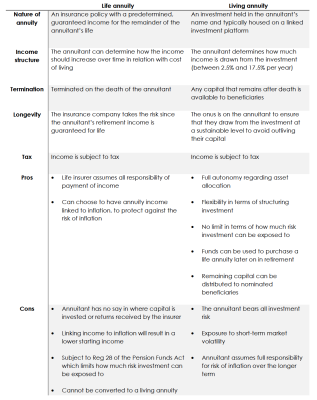
It is therefore important that if you select a living annuity, your investment grows at a sufficient rate to avoid your savings from being reduced as your monthly income is drawn from your retirement savings.
You are also able to select a hybrid option which is a combination of a living and a life annuity for the best of both worlds. Discuss these options with your advisor to determine the most suitable option for your needs.
Also remember to review your retirement strategy with your financial advisor on an annual basis, to ensure that you are on track with meeting your retirement goals.